See prices From 35 EUR · Free cancellation available
Contents
The best time to see northern lights in Norway runs from late September through early April, with the strongest odds falling between November and February when Tromso sits deep in its dark season. Here is what I would actually do with that window: pick a trip length of at least three or four nights somewhere in the middle of that range, rather than the edges, and book a tour that is free to chase clear sky rather than one tied to a fixed early return time. This page works through the month-by-month odds, the polar night, moon phases and trip-length planning in one place, since most searches for a “best month,” “best season” or “when to go” are really asking the same underlying question, and I would rather answer it once, in full, than send you chasing a dozen near-identical articles. If price and product choice matter as much as timing to you, it is worth comparing all eight Tromso Northern Lights tours by season and price before you lock in dates, since a few operators run cheaper shoulder-season fares that a fixed “peak month” search would miss.
When Is the Northern Lights Season in Norway?
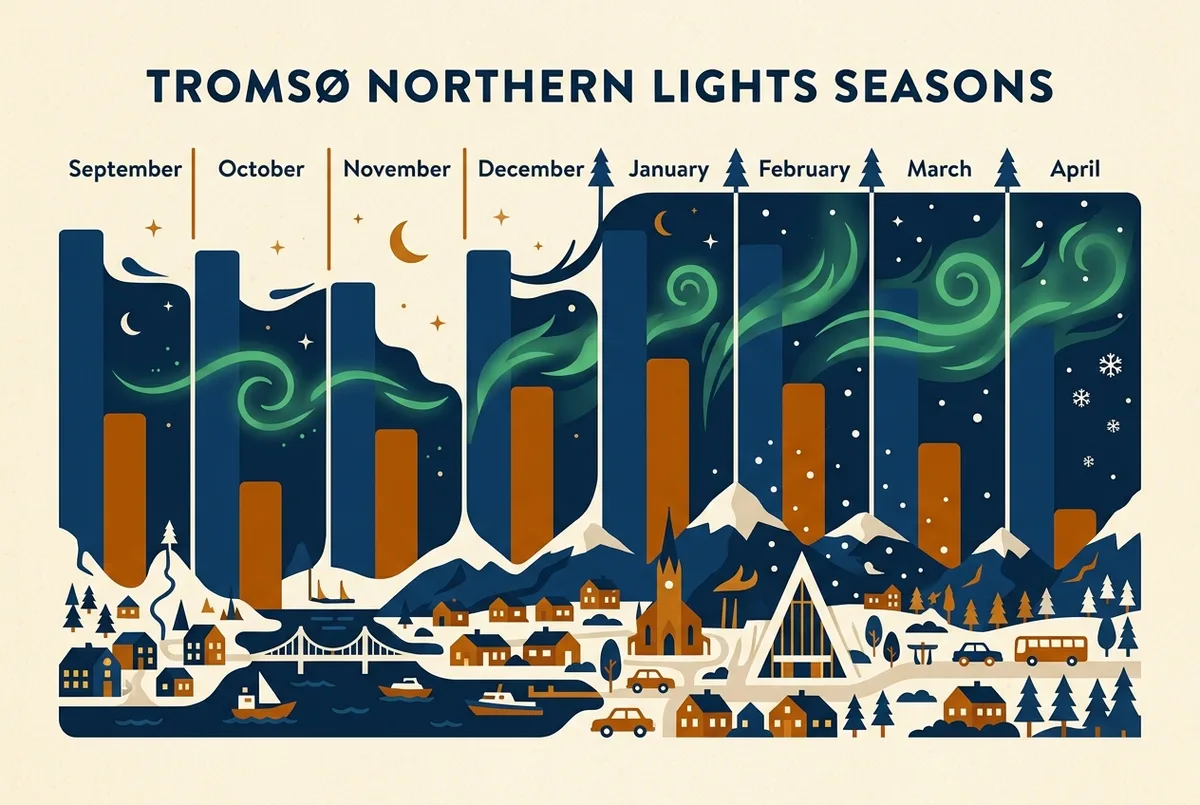
The core season in Tromso runs from around September 21 to April 1, roughly six and a half months, which is longer than most visitors expect and considerably longer than the three-month “peak” window most travel articles mention.
I would not narrow your search to only the three darkest months if your travel dates are flexible for other reasons, like flights or work. A late-September or mid-March trip still sits inside a genuinely dark, active season, and both edges come with real advantages: shorter queues at hotels, easier tour availability, and in March, the return of enough daylight to actually enjoy the daytime sightseeing between aurora attempts.
I would also point out that six and a half months is a genuinely wide window compared to how most travel guides frame it. Treating this as a single long season, rather than a short “peak” flanked by two throwaway shoulder periods, is the more honest way to think about planning a Tromso trip.
Check prices & dates
Ready to visit?
Book your tickets in advance: popular time slots sell out.
What Is the Polar Night, and Why Does It Matter for Your Odds?
Tromso’s polar night runs from roughly late November to mid-January, when the sun does not rise above the horizon at all, giving guides close to continuous darkness rather than just a few dark hours after sunset.
I would call this Tromso’s biggest structural advantage over destinations further south. More dark hours per night simply means more time for a forecast-led guide to find a gap in the clouds somewhere across the region, since a chase tour is not racing a sunrise the way it would be in, say, southern Norway or the UK. My guide to Tromso’s winter weather and daylight hours breaks down exactly how dark, and how cold, each part of the season actually gets.
Month-by-Month Odds: When Should You Actually Book?
Month
Darkness hours
Typical weather
My read
Late September
Moderate, growing nightly
Mild, occasional rain
Good value, fewer crowds, decent odds
October
Long, dark by early evening
Cooling, more cloud
Solid early-season pick
November
Very long, polar night begins
Cold, variable cloud
Strong start to peak season
December
Full polar night
Cold, snowy
Peak darkness, busy holiday period
January
Full polar night
Coldest month
My personal pick for the best balance
February
Long, sun returning briefly
Cold, often clearer skies
Strongest month for clear-sky stretches
March
Shortening nights
Milder, more daylight
Great for combining daytime activities
Early April
Short nightly window
Milder
Last reliable window, low crowds
I would treat this table as a guide to trade-offs, not a strict ranking. Every month from late September to early April gives you a genuine shot, and the operators featured on this site run chases every clear night across the whole window, not just in the three “peak” months.
What’s the Single Best Month to See the Northern Lights in Tromso?
If I had to pick one month, I would pick February. By February the polar night has passed, so you get a little useful daylight for sightseeing, but the nights are still long and dark, and in my experience Tromso’s weather tends to clear up more often in late winter than in the stormier, wetter months of November and December.
That said, I would not talk anyone out of a January trip. January carries the last stretch of true polar night and, for a lot of travelers, the atmosphere of near-permanent darkness is part of the appeal in itself, not just a means to an end.
Does Solar Cycle Activity Change the Best Time to Visit?
Somewhat. Solar activity runs on an roughly 11-year cycle, and years closer to a solar maximum produce more frequent, stronger displays than the quieter years near a solar minimum, independent of which month or season you pick.
I would not reschedule a planned trip around long-range solar cycle predictions, though, since those forecasts are only useful in broad strokes years out and say nothing about any single night. What I would do is treat a higher-activity period as a reason to feel more confident about a shorter trip, and a quieter period as a reason to book a couple of extra nights out to compensate. My guide to the Kp index and solar activity explains how this cycle actually affects your odds on the ground in more detail.
Is a Shoulder-Season Trip in September or April Worth the Trade-off?
Yes, if lower prices and thinner crowds matter more to you than squeezing out the absolute darkest possible nights. Late September and late March into early April both still fall inside a genuinely dark, active season, just with shorter nightly windows than the December-to-February core.
I would actually recommend a shoulder-season trip to budget-conscious travelers without hesitation. Hotel rates and tour availability both ease up outside the December-to-February rush, and a slightly shorter dark window still gives a forecast-led guide plenty of time to work with on a clear night. My guide to budget Tromso aurora tours covers exactly how much a shoulder-season booking can save compared to a peak-week trip.
Does the Time of Night Matter as Much as the Month?
Yes, in a different way. Within any given night, the aurora is most commonly reported between roughly 6pm and 1am in Tromso, since that window combines real darkness with the hours when geomagnetic activity and clear sky most often line up.
I would not book a tour with an early fixed return time if I could avoid it. A guide who can stay out past midnight has a real edge, because some of the strongest displays I have seen operators report happen well after 11pm, once the crowds and the early-evening cloud bands have moved on.
Should You Avoid Booking Around a Full Moon?
Not necessarily. A bright full moon washes out faint aurora the same way city light pollution does, but it does not erase a genuinely active display, and a moonlit fjord actually photographs beautifully with some ambient light on the foreground instead of pure black.
I would treat a new-moon week as a small bonus if your dates are already flexible, rather than something worth restructuring a whole trip around. Cloud cover and solar activity do far more to decide your actual odds on any given night than where the moon sits in its cycle.
How Many Nights Should You Budget for a Real Chance?
I would budget at least two separate evenings out, and three if your schedule allows it. No single night, however well timed, can guarantee a sighting, since that ultimately depends on solar activity and cloud cover neither you nor any guide controls.
Booking two or three shorter, cheaper chase nights rather than one expensive premium tour is, in my view, a smarter way to spend a fixed budget, since it spreads your risk across multiple independent weather windows instead of betting everything on one evening. Once you land, checking tonight’s Tromso aurora forecast each afternoon helps you and your guide pick which of those nights is actually worth going out on.
What If You Only Have One or Two Nights in Tromso?
I would still go for it, but I would pick the timing more carefully. On a single-night trip, I would check the forecast as early as possible and, if the outlook is genuinely poor, consider shifting your one evening out by a day if your itinerary allows any flexibility at all.
I would also lean toward a tour with the widest possible search radius on a short trip, since a guide who can drive further to find clear sky gives a single-night attempt its best realistic shot. A tighter, fixed-route tour makes more sense once you already have a backup night in reserve, but on a one-shot trip I would rather maximize range than save a little money.
Does Traveling With Kids Change the Best Time to Go?
A little, yes. Families are often better served by a slightly earlier evening window and a month outside the coldest depths of the polar night, since a warm-vehicle chase with a reasonable bedtime is generally an easier sell to tired kids than a nine-hour midwinter bus ride.
I would lean toward late November, February or March for a family trip, since all three still sit inside the strong season but avoid the very coldest, darkest stretch of December and January. My guide to northern lights tours for families in Tromso covers which tour formats and age minimums actually suit younger travelers best.
Where Should You Actually Go to Watch, Once the Timing Is Right?
Timing gets you into the right season and the right night, but location still decides whether city light pollution ruins an otherwise good display. My guide to the best places to watch the northern lights around Tromso covers the specific viewpoints and why a chase tour usually beats staying in the city centre.
I would treat timing and location as two separate problems that both need solving, not one. Plenty of visitors get the month right, then stand on a lit-up harbour and wonder why the display looks faint compared to the photos they had seen online.
How Does Tromso Compare to Other Norwegian Bases for Timing?
The season length and polar-night advantage described above apply specifically to Tromso’s latitude; other Norwegian bases shift the calculus in smaller ways. My comparison of the best places to see the northern lights in Norway scores Tromso against Alta, Lofoten, Bergen and several other cities on exactly this kind of trade-off.
I would still call Tromso the easiest all-round choice on timing alone, mainly because its flight network means you are not losing a travel day to reach a remote base during the exact weeks when darkness is most valuable.
Does a Multi-Night Guarantee Change When You Should Book?
Some Tromso operators offer a free rejoin on a later night if your first attempt gets clouded out, and if a tour you are considering includes one, I would treat that as a genuine reason to book earlier in your trip rather than saving your one evening for the very last night.
I would rather use a rejoin guarantee to cover a bad-luck first attempt in December than gamble my only chase night on the last evening of a short trip. Booking early also gives you room to try a second, different tour later if the first one’s format was not quite what you expected, which is a small but real planning advantage worth factoring into when you book.
My Honest Recommendation on When to Go
If I were booking today, I would pick a week in late January or February, arrive with at least three nights free for a chase, and book an aurora borealis tour in Tromso with no fixed early return time. That combination gives you real darkness, a reasonable shot at clearer late-winter skies, and enough attempts to absorb one or two cloudy nights without the trip feeling wasted.
I would not overthink the exact week beyond that. The season and Tromso’s latitude do most of the real work, and a guide reading that specific night’s live conditions will always beat a traveler trying to guess the “best time” from a generic online rule. If your dates are already fixed for reasons outside your control, work with what you have rather than second-guessing them: every month from late September to early April genuinely belongs in this guide’s answer, not just the three headline peak months.
Frequently Asked Questions
What is the best month to see the northern lights in Norway?
I would pick February for the best balance of long dark nights and clearer late-winter weather, though any month from November through February gives you a genuinely strong chance in Tromso.
Is it better to visit Tromso during the polar night?
It is a real advantage, since near-continuous darkness from late November to mid-January gives a forecast-led guide more hours each night to find clear sky somewhere in the region.
Does a full moon ruin the northern lights?
No, not a genuinely active display. A full moon washes out faint aurora the way city lights do, but a strong display still shows up clearly, and it can make for a more atmospheric photo.
How many nights should I plan for a real chance of seeing the aurora in Tromso?
I would plan at least two, and three if possible, since spreading your attempts across multiple nights manages the real risk that any single evening turns out cloudy.
Is there a bad month to visit Tromso for the northern lights?
Not really, within the late-September to early-April window. Every month in that range gives you genuinely dark, active nights; the differences between them are more about crowds, weather variability and daylight than any month being a poor choice outright.
Is late September or early April too late in the season?
No. Both edges of the season still carry genuinely dark, active nights, and you get the bonus of thinner crowds and often better tour availability than the busy midwinter months.